Fall Mushrooms of the Sierra Nevada: What to Look For and Where They Grow
There's something magical about walking through a Sierra Nevada forest after the first autumn rains. The scent of damp pine needles fills the air, fallen leaves cover the forest floor, and beneath the trees, an extraordinary world begins to reveal itself.
Mushrooms.
Some appear almost overnight, emerging from soil that seemed completely undisturbed just days earlier. Others grow from fallen logs, decaying branches, or the trunks of living trees. Some are small and easily overlooked, while others display remarkable colors, shapes, and textures.
But what we're seeing above ground is only part of the story.
Most fungi spend much of their lives hidden within soil, wood, and other organic material. The mushrooms we recognize are the reproductive structures of these organisms, appearing when environmental conditions are favorable.
Throughout California's Sierra Nevada, including the forests of Tuolumne County and the Highway 108 corridor near Yosemite, fall can be a fascinating time to explore this largely unseen world.
Whether you're new to mushroom identification, an experienced nature enthusiast, or simply curious about what's growing along your favorite forest trail, understanding where mushrooms live and why they appear can transform the way you experience the forest.
When Is Fall Mushroom Season in the Sierra Nevada?
One of the most common questions people ask is: When do fall mushrooms start appearing in the Sierra Nevada?
The answer depends more on environmental conditions than on a particular date.
Autumn mushroom activity is influenced by several interacting factors:
Moisture: Rainfall and sustained soil moisture can encourage many fungi to produce mushrooms.
Temperature: Cooler autumn temperatures may favor some species, while others require different conditions.
Elevation: Forests at different elevations experience different temperatures, precipitation patterns, and seasonal transitions.
Forest habitat: Tree species, soil characteristics, dead wood, and other environmental conditions influence which fungi are present.
Recent weather: A single rainstorm doesn't guarantee a mushroom flush. The amount of moisture, its duration, and the conditions that follow all matter.
In the Sierra Nevada, higher elevations generally cool earlier than lower elevations. However, fall mushroom activity doesn't necessarily follow a predictable downhill progression.
An early storm may bring favorable conditions to one area while another remains too dry, too cold, or otherwise unsuitable.
The best time to look for mushrooms is when the conditions are right for the species and habitat you're exploring—not simply because the calendar says October.
And while fall is an exciting season, fungi can be observed throughout much of the year. Different species respond to different seasonal conditions, and some wood-associated fungi may remain visible long after they first develop.
Five Fascinating Fungi to Learn About in Sierra Nevada Forests
The Sierra Nevada supports an extraordinary diversity of fungi, from familiar mushrooms growing on the forest floor to unusual structures emerging from wood.
The following five examples illustrate some of the different forms, habitats, and ecological relationships worth learning about.
Their appearance and fruiting seasons vary, and not every species will be present in every Sierra Nevada forest or during every autumn.
1. Porcini: A Mushroom Connected to the Forest's Trees
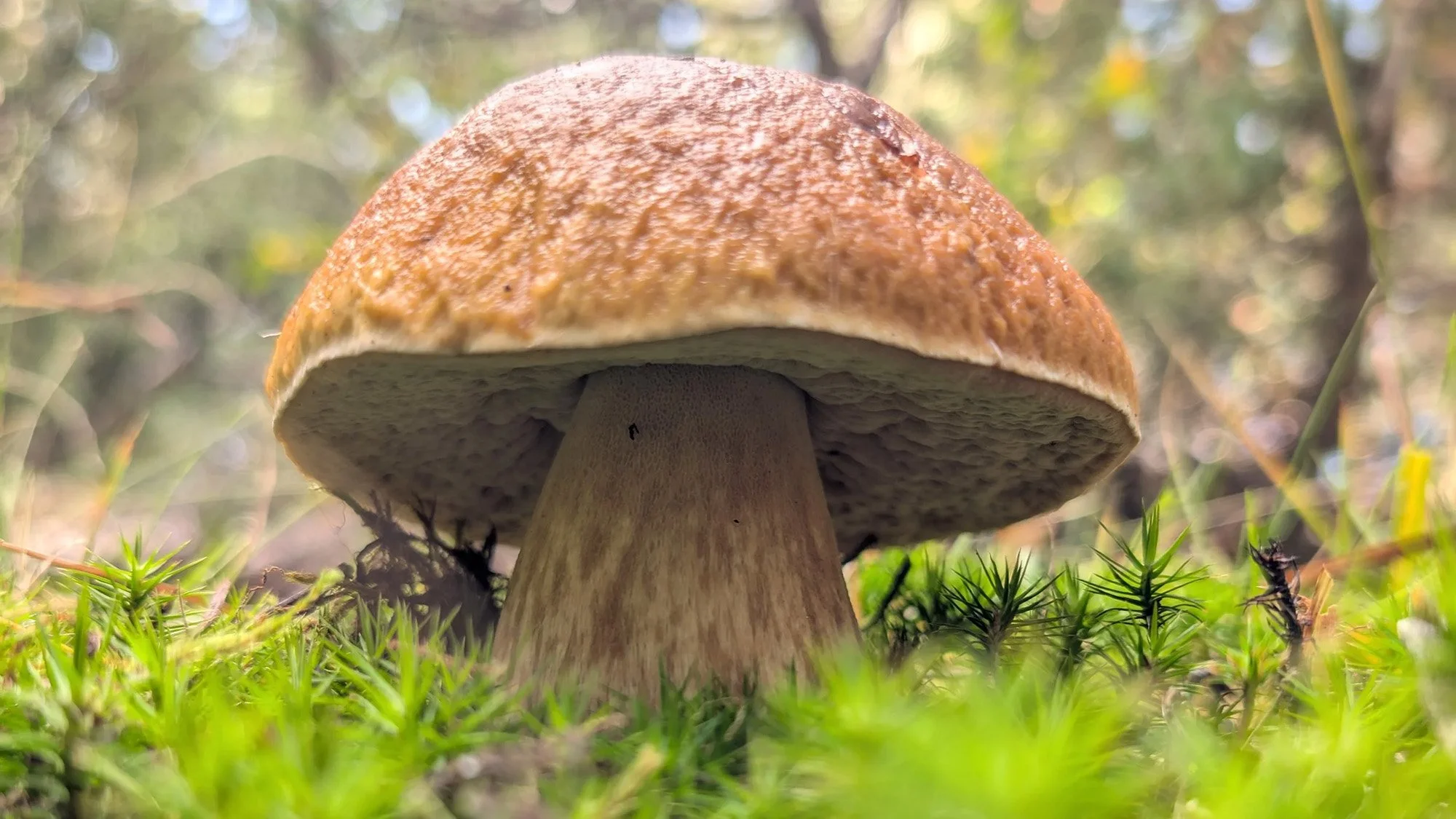
Porcini mushrooms form important relationships with forest trees, connecting the hidden world of fungi to the health of Sierra Nevada ecosystems.
Porcini are among the most recognizable mushrooms associated with conifer forests.
The name porcini is commonly used for members of the Boletus edulis species complex, although accurate identification can require distinguishing them from similar boletes.
These mushrooms often have substantial stems, rounded caps, and a sponge-like layer of pores beneath the cap rather than the gills found on many familiar mushrooms.
But one of the most interesting things about porcini isn't their appearance. It's their relationship with trees.
Porcini are ectomycorrhizal fungi, meaning they form close associations with the roots of compatible trees.
Through these relationships, the fungus can help the tree obtain water and mineral nutrients, while receiving carbon compounds produced through photosynthesis.
This is an important reminder that a mushroom isn't simply growing near a tree by coincidence. In some cases, the relationship between the fungus and the tree is fundamental to the fungus's life cycle.
When observing porcini or similar boletes, pay attention to the surrounding tree species, soil conditions, elevation, and the structure of the mushroom itself.
These environmental details are often just as interesting as the mushroom's appearance.
2. Amanita muscaria: A Beautiful Reminder to Look Closely

The striking colors of Amanita muscaria and its close relatives make them some of the forest's most recognizable mushrooms, but their beauty is no indication of edibility.
Few mushrooms are as visually recognizable as the classic red-and-white fly agaric, Amanita muscaria.
Its bright cap and pale surface patches have made it a familiar image in illustrations, folklore, and popular culture.
However, North American fly agarics include closely related forms whose classification continues to be studied. Not every red-and-white fly agaric should automatically be assigned the name Amanita muscaria in the strict taxonomic sense.
Amanita mushrooms also offer an excellent introduction to the importance of examining the entire mushroom.
Depending on the species, identification features may include:
Cap color and surface texture.
Gills beneath the cap.
A ring or partial-veil remnants on the stem.
Structures around the stem base.
The surrounding trees and habitat.
Some important identification features may be hidden beneath soil or forest litter.
Fly agarics and their relatives form mycorrhizal relationships with trees, making them another example of the intricate connections beneath the forest floor.
Important: Fly agarics contain toxic psychoactive compounds and should never be treated as safe to eat based on appearance, folklore, or information from photographs.
The genus Amanita also contains some of the world's most dangerously poisonous mushrooms.
For beginners, these fungi are best approached as subjects for observation, photography, and careful study.
3. Chicken of the Woods: Bright Colors on Living and Dead Trees
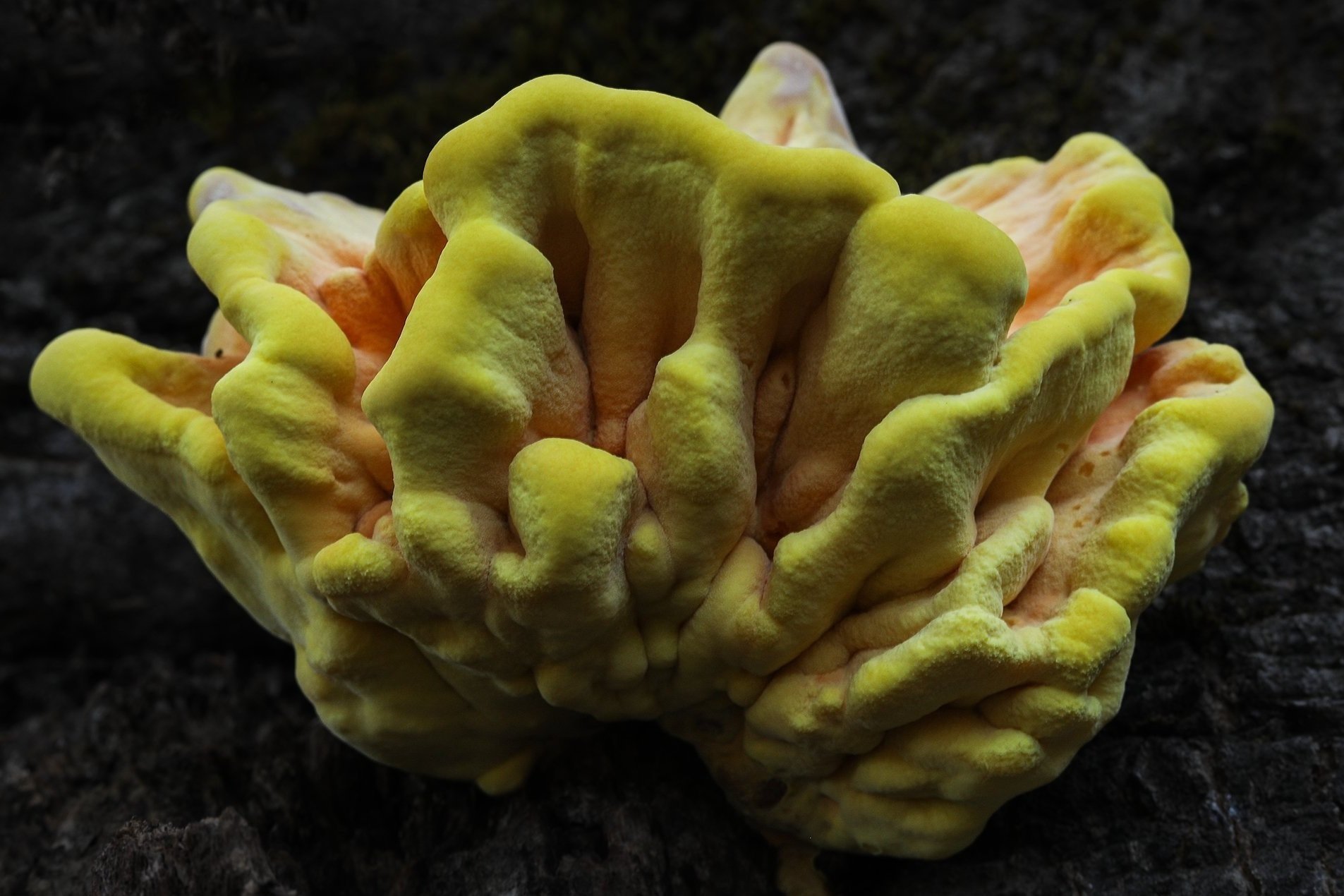
Chicken of the Woods mushrooms are known for their vibrant colors and layered, shelf-like growth. These wood-decaying fungi play an important role in Sierra Nevada forest ecosystems.
Chicken of the Woods is a common name applied to several species in the genus Laetiporus.
These fungi are often recognized by their overlapping, shelf-like growth and striking yellow, orange, or salmon-colored surfaces.
Unlike porcini, which form beneficial associations with tree roots, Laetiporus species are wood-decaying fungi.
They obtain nutrients by breaking down components of wood and can cause brown rot in affected trees.
Depending on the species, they may grow on living trees, dead standing trees, stumps, or fallen wood.
Chicken of the Woods provides a useful lesson in why habitat matters during mushroom identification.
The host tree, the location of the fruiting body, the color of the pore surface, and the structure of the growth can all help narrow down possibilities.
Different Laetiporus species have different distributions and host associations, so identifying every orange shelf fungus as the same species is a mistake.
Although some members of this group are collected as edible mushrooms, the common name alone is not enough to establish identification or safety. Adverse reactions can occur, and this article should not be used to determine whether a specimen is edible.
For nature photographers, their layered forms and vivid colors can make particularly interesting subjects against dark bark and forest shadows.
4. Oyster Mushrooms: Nature's Wood Recyclers
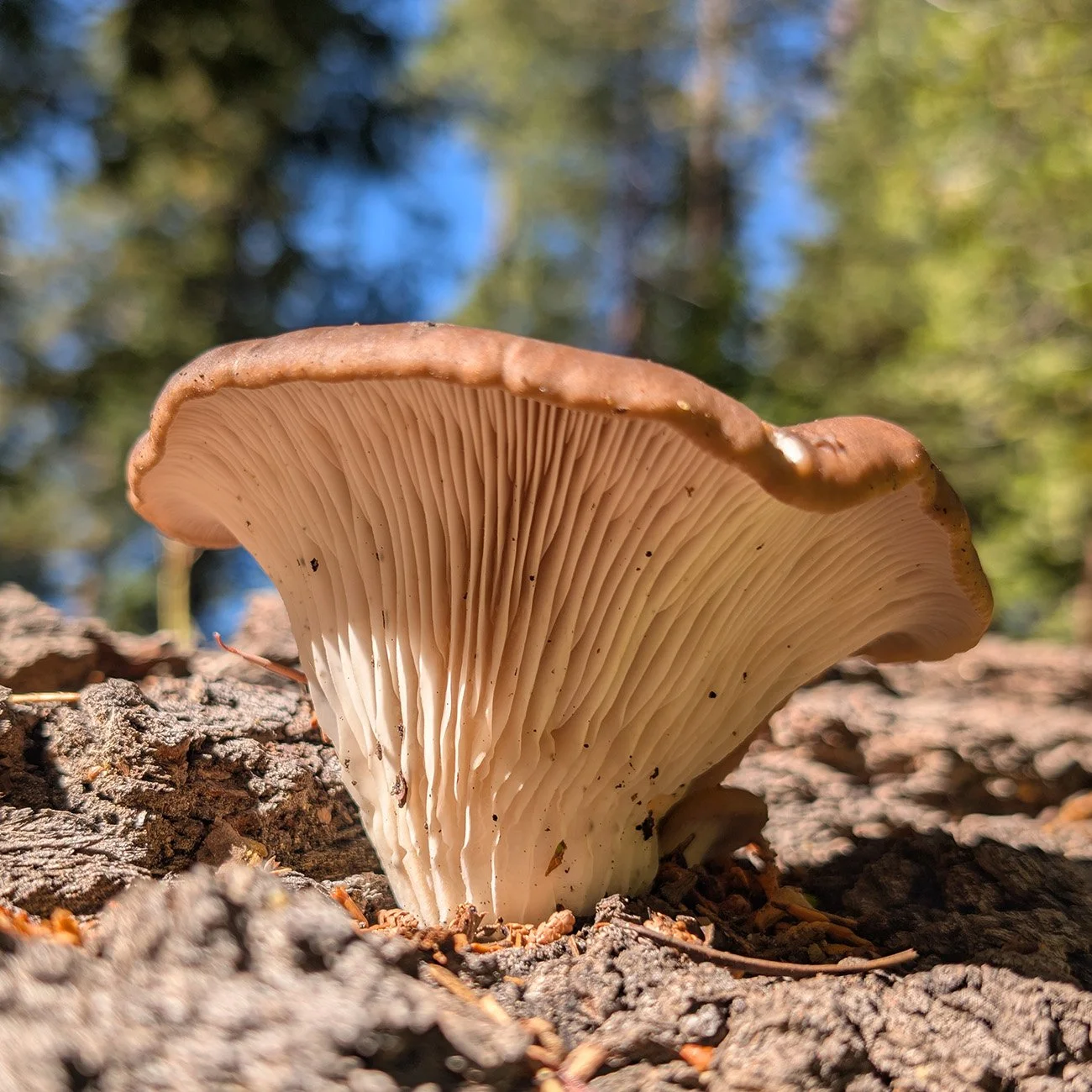
Oyster mushrooms help break down dead and decaying wood, recycling nutrients and supporting the natural balance of Sierra Nevada forest ecosystems.
Oyster mushrooms, generally associated with the genus Pleurotus, are another fascinating group of wood-associated fungi.
Many have broad, fan-shaped caps, pale gills that extend down a short or off-center stem, and overlapping clusters that grow from wood.
Their shapes can vary considerably depending on species, age, and growing conditions.
Oyster mushrooms are primarily decomposers, breaking down woody material and contributing to nutrient cycling within forest ecosystems. Some species may also colonize weakened living trees.
This process is essential to forest health.
Without decomposer fungi, fallen branches, dead trunks, and other woody debris would accumulate much more slowly through natural breakdown.
As fungi help decompose this material, nutrients become available to other organisms, supporting the larger forest ecosystem.
When studying oyster-like mushrooms, pay attention to the wood they're growing on, the attachment of the stem, the gill structure, and the overall arrangement of the fruiting bodies.
Several unrelated mushrooms can resemble oysters, and photographs alone may not reveal enough information for reliable identification.
Their ecological role is a compelling reason to appreciate these fungi even without collecting them.
5. Lion's Mane and Other Hericium Fungi: Mushrooms with Teeth Instead of Gills
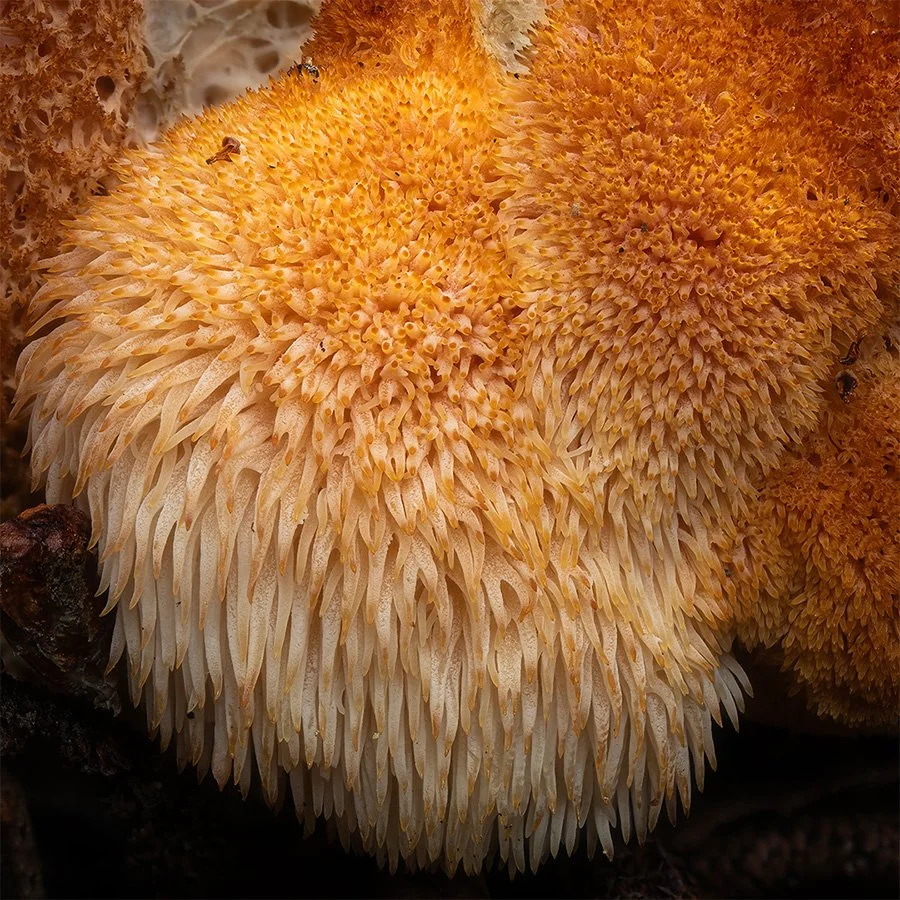
Lion's Mane and related Hericium fungi produce distinctive, tooth-like spines instead of traditional gills,
demonstrating the remarkable diversity of mushrooms found in forest ecosystems.
Not all mushrooms have caps, stems, or gills.
Lion's Mane and related Hericium species produce distinctive white to cream-colored fruiting bodies covered with hanging spines.
These spines, sometimes called teeth, are structures where spores are produced.
The familiar name Lion's Mane generally refers to Hericium erinaceus, but other Hericium species produce branched or clustered forms that can look quite different.
These fungi grow in association with wood, often on hardwood trees, and can be involved in wood decay.
Their unusual appearance makes them especially interesting for anyone learning about mushroom diversity.
A beginner might imagine that all mushrooms share the familiar umbrella shape, but fungi produce an enormous variety of reproductive structures.
Some have pores, others have gills, some form shelves, and others produce spines or intricate branching structures.
Lion's Mane and its relatives demonstrate why learning mushroom identification means understanding structures and ecological relationships—not simply memorizing pictures.
Where Should You Look for Fall Mushrooms in the Sierra Nevada?
Finding mushrooms becomes much more interesting when you begin looking for suitable habitats rather than searching randomly.
Different fungi depend on different environmental conditions and resources.
Beneath Conifers and Other Forest Trees
Many familiar forest mushrooms form mycorrhizal relationships with living trees.
Depending on the species, these fungi may be associated with pines, firs, oaks, or other compatible hosts.
In the Sierra Nevada, the mix of tree species changes with elevation, exposure, and local conditions.
Learning to recognize the trees around you can be an important part of learning to recognize mushrooms.
On Fallen Logs, Stumps, and Standing Trees
Dead and decaying wood supports a remarkable diversity of fungi.
Some produce visible mushrooms, brackets, or shelves, while others remain largely hidden within the wood.
Look carefully at fallen logs, old stumps, dead branches, and standing trees.
Different stages of decomposition can support different fungal communities.
In Moist Forest Microhabitats
Moisture doesn't remain evenly distributed throughout a forest.
Shaded areas, protected depressions, deep forest litter, and certain north-facing slopes may retain moisture differently from exposed locations.
These small environmental differences can influence where mushrooms appear.
However, damp ground alone doesn't guarantee mushroom activity. The appropriate fungus must already be present, and other conditions must also be favorable.
Across Different Elevations
A lower-elevation oak woodland and a high-elevation conifer forest can support very different fungal communities.
Temperature, moisture, host trees, and seasonal conditions all change as you move through the mountains.
For mushroom enthusiasts, learning these relationships is often more rewarding than simply trying to find the greatest number of mushrooms.
How to Start Identifying Wild Mushrooms
Mushroom identification is a skill developed through observation, study, and experience.
One of the biggest mistakes beginners make is trying to identify a mushroom from a single photograph of its cap.
A more useful approach is to document several characteristics together.
Start with these questions:
Where is it growing? On soil, wood, buried roots, or another substrate?
What trees are nearby? Are there pines, firs, oaks, or other possible host species?
What does the underside look like? Does it have gills, pores, teeth, or another structure?
What is the stem like? Is it central, off-center, thick, slender, ringed, or absent?
What is the overall structure? Is it a solitary mushroom, a cluster, a shelf, or a branching growth?
What environmental conditions are present? Consider elevation, moisture, season, and recent weather.
Photographing the mushroom from multiple angles, including its underside and habitat, can make later study much more productive.
Field guides, regional mycological organizations, microscopy, and knowledgeable identifiers can all contribute to the learning process.
Identification apps may help suggest possibilities, but their results should be treated as starting points rather than authoritative conclusions.
Never eat a wild mushroom based solely on an app, photograph, common name, or identification from this article. Some poisonous species closely resemble edible mushrooms, and mistakes can cause severe or fatal poisoning.
Responsible Mushroom Observation in Sierra Nevada Forests
Exploring fungi should go hand in hand with protecting the places where they grow.
A few simple habits can make a difference:
Stay on established trails and legally accessible routes when appropriate.
Avoid unnecessary trampling of fragile vegetation and forest habitats.
Respect private property, public-land regulations, and seasonal closures.
Check applicable collection rules before removing mushrooms or other forest materials.
Avoid disturbing more habitat than necessary for observation or photography.
Leave unfamiliar mushrooms unconsumed.
National Forest regulations and collection requirements can vary by location, forest, species, quantity, and intended use.
In the Stanislaus National Forest and other Sierra Nevada public lands, always consult the managing agency's current rules before collecting mushrooms.
You don't need to harvest mushrooms to appreciate them.
Some of the most rewarding discoveries come from simply observing their forms, studying their relationships with trees, and photographing them in their natural surroundings.
Mushroom Photography: Learning to See the Smaller Forest
Photography is one of my favorite ways to explore the world of fungi.
A mushroom that looks ordinary from standing height can become extraordinary when viewed from ground level.
The underside of a cap, the texture of a stem, the intricate structure of gills, or the way light filters through surrounding vegetation can reveal details that are easily missed.
Photography also encourages patience.
Instead of walking quickly through the forest looking for the next mushroom, you begin to notice the environment around each discovery.
What kind of tree is nearby? Is the mushroom emerging from soil or wood? How does the surrounding habitat influence its appearance?
These observations can make you a better photographer and a more thoughtful student of fungal ecology.
And when you photograph mushrooms carefully, you create a valuable visual record that can support future learning and identification.
Discovering the Sierra Nevada, One Mushroom at a Time
The more time you spend studying fungi, the more you realize that mushrooms are not isolated objects scattered across the forest floor.
They're part of an intricate network of relationships involving trees, soil, moisture, decomposing wood, microorganisms, and countless other living things.
Porcini help illustrate the connections between fungi and tree roots.
Amanita species remind us that beautiful mushrooms can be chemically complex and potentially dangerous.
Chicken of the Woods, oyster mushrooms, and Hericium species reveal the essential role fungi play in the decomposition of wood.
Each discovery offers another opportunity to understand how Sierra Nevada forests function.
Through Say Hi to Fungi, I share my fascination with mushroom identification, fungal ecology, and nature photography, particularly in the Sierra Nevada mountains I have spent decades exploring.
For those interested in exploring Sierra Nevada fungi through guided outdoor experiences, my other business, Ikigai Adventure Tours (https://www.ikigaiadventuretours.com/fungi-forays), offers seasonal mushroom identification and ecology tours when scheduled.
Whether you're exploring with a guide or enjoying a quiet walk through the forest, remember that discovering mushrooms isn't only about finding something unusual.
It's about learning to notice the extraordinary world that's been there all along.
Happy exploring—and say hi to the fungi!
Courtney Risdon is a Sierra Nevada nature photographer, outdoor guide, and the creator of Say Hi to Fungi.
He also owns Ikigai Adventure Tours Inc., which offers guided outdoor education and experiences in California's Sierra Nevada.